EXAMPLE RESULT
Gemma 4
26B-A4B IT
A comparison between one GPU and an NVLink pair, using the same lab protocol.
AWQ · W4A16ONE LAB, REAL RESULTS
Explore the lab’s hardware and see what AI models actually do on RTX 3090 FE GPUs.
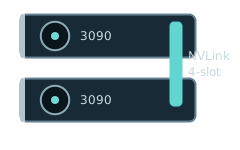
2D hardware diagram · choose a configuration below.
3D model adapted and simplified from Kirigami’s 3090 FE, CC BY 4.0. Inspect the NVLink bridge ↗
02 / UNDERSTAND
Every experiment has a specific context. Here is a traceable example from the existing dataset.
EXAMPLE RESULT
A comparison between one GPU and an NVLink pair, using the same lab protocol.
AWQ · W4A16Tokens per second · French prompt · 512 output tokens per run · protocol speed-house/v1 · vLLM 0.29.0. Separate runs linked to their source records.
Each pair has 24 GB on each card. Using both memories requires software that distributes the workload; NVLink alone does not turn them into a single GPU. The two pairs run in separate virtual machines, not one four-GPU model.
Understand the scope ↗03 / FOLLOW THE EVIDENCE
The benchmark catalogue groups reviewed lab runs by model. Open a run to see its recorded hardware, software and protocol.
The Gemma comparison above comes from a dated sample. Browse the benchmark catalogue ↗
View the data snapshot ↗GPU model: adapted from Kirigami’s 3090 FE model, CC BY 4.0; geometry and textures were simplified for the web. The NVLink bridge is schematic.
04 / TECHNICAL LAB
Compare Three.js and Babylon.js using the same scene description and camera path. Each engine triangulates some shapes differently; only one runs at a time.
The test measures frame intervals and initialisation time, not electricity use. Results depend on the device, browser, cache and display refresh rate. The camera follows the same path for each test; it stays still when reduced motion is requested.